Monday, October 5, 2015

Life, The Universe, and Everything

There are a lot of different theories about how the universe was created. The fact of the matter is, no one really knows. Sure, we can make logical guesses based on specific factors, but all in all no one really knows for sure how our universe came to be. 
 Two people by the name of Scott and McClure had a few ideas of their own. They're beliefs on how the universe came to be stemmed into five main groups:
  • Creation ex nihiloin which the creation is through the thought, word, dream or bodily secretions of a divine being.

    These myths see creation as a result of divine emissions as 'vomit, sweat, urination, defecation, masturbation, web-spinning, etc. This is just gross. There isn't any, one specific flaw with this, the whole thing just makes no sense in comparison to what we know about our normal theory of how the universe came to be.
    -
  • Earth diver creation in which a diver, usually a bird or amphibian sent by a creator, plunges to the seabed through a primordial ocean to bring up sand or mud which develops into a terrestrial world
    -this is normally though of as the miracle of birth; life emerging from the smallest particle. These myths typically begin with a primordial sea into which the god descends to bring back the materials necessary for creating the world.
    The problem with this myth is that it doesn't explain the creation of other plants such as mars that don't have water. 
  • Emergence myths in which progenitors pass through a series of worlds and metamorphoses until reaching the present world
    -In these myths, a first creature, human, or race enters our world from another world. The first world parallels the womb and is often too small for its occupant. This is the myth about evolution of humanity; humans as participants in creation. This myth is also flawed because we have evidence of earth and creature on Earth that existed long before human type species.
  • Creation by the dismemberment of a primordial being. Basically creation has a cost.
    These myths focus on creation as a consequence of the sacrifice of a god. Typically the sacrificed bodies become some part of the newly created world. The flaw with this theory is there is no type of evidence to support this. We can make assumptions that the big bang theory is what created our universe by inferring specific things using "proof" that craters hit our planets due to the giant holes we have. There is nothing to use as a form of evidence or "proof" that there was a god that sacrificed something and that's how we got our universe. 
  • Creation by the splitting or ordering of a primordial unity such as the cracking of a cosmic egg or a bringing order from chaos. This is basically the myth of making room for life. These myths focus on separating the various parts of the universe and embuing certain portions with life or the potentiality for life. The problem with that is there is life all over the universe. It may not be life like you and I but there is still life. There is life all over our planet, it's not just in specific parts.

    Although there are many more ideas beyond this as to how our universe was created, we normally associate the most...logical idea to be the Big Bang Theory. This theory is
    "The prevailing cosmological model for the universe from the earliest know periods through its subsequent large-scale evolution." In 1929 Edwin Hubble discovered that the Universe is expanding at an enormous speed. Hubble noted that galaxies outside our own Milky Way were all moving away from us, each at a speed proportional to its distance from us. He quickly realized what this meant that there must have been an instant in time (now known to be about 14 billion years ago) when the entire Universe was contained in a single point in space. The Universe must have been born in this single violent event which came to be known as the "Big Bang." This is the theory that we mostly follow today as to how our universe was created. It follows many scientific beliefs because we base this theory off of things we can try to prove thanks to animals, frozen in time (fossils), by calculating the age of dirt, and by calculating specific groups of fossil fuels. Unlike the theories above, we are basing the big bang theory off of science, measurements, calculations, all tangible things that we can prove. Because of that, the Big Bang Theory is that of which makes most sense to teach to the younger generations.


Wednesday, September 16, 2015

Solar System Budget

If you had $100.00 you could use between all the mass in our solar system, how would you divvy it up? I would say That because the sun is pretty important I would give that half of my budget, so $50.00. For the remaining portion of my budget  I would start by taking out $10.00 and dedicating $5.00 to comets, asteroids, meteors, and dust particles, and the other $5.00 to the minor planets. So now spending $10.00 on that and $50.00 on the sun, I have $40.00 left. I would separate the rest of this into the planets. I would give Jupiter $10.00 because it is the biggest planet. Then comes Saturn (next biggest planet) I would give that $9.00. I now have $21.00 left. I'd give Neptune $7.00 which leaves me with $14.00. I have to divide this with the planets that are left, the rocky planets, since we already covered the gas giants. I would give Earth $5.00, Venus $4.00, Mars $3.00 and Mercury $2.00. That would take up the rest of my budget.

After looking where these were actually ranked I was wayyyy off. The sun actually takes up 99.85% of mass, or $99.85 out of our $100.00 budget. For the rest of the plants, starting with the gas giants, Jupiter takes up 10.6% mass or 10.6 cents, Saturn takes up 3.2 cents, Neptune takes up .0006 cents, and Uranus takes up .005 cents. For the rocky planets, Earth and Venus take up .0003 cents, Mars takes up .00004 cents and Mercury takes up .00002 cents of our budget.

A Private Universe

The Earth is a fascinating and mysterious object. It took a lot of discoveries for us to come to know what we know about it and its axes today. A classic question is "what are the reasons for the seasons?" A lot of people use this play on words in terms of holidays like Christmas, for example "What is the reason for the Christmas season?" Today we are going to talk about it in a more literal sense. We have season on earth because we are on a tilted axes. This tilt causes us to get the season we experience. The earth is always "pointing" (tilted) to one side as it goes around the sun. Sometimes the sun is in the direction that the earth is pointing, but not at other times. The earth receives indirect light from the sun because of this tilt. What this means is the light is angled when it hits us, it doesn't hit us straight on. This indirect source of sunlight with the tilt of our axes causes the seasons, in other words they are the "reason for the seasons."


Another fascinating part of our planted is our moon. We only have one but our moon goes through different phases. A great question that a student may as is "how are phases of the moon created?" Phases of the moon are created based on where the sun, earth and moon are in correlation to each other. What I mean by this is as the moon rotates, around the earth, it is being illuminated from various angles by the sun. These various angles create the different phases of the moon we see at night throughout the year. For an example, at the new moon phase, the earth is directly between the moon and the sun, that is why it's so dark. Use the diagram below as reference.

Friday, September 11, 2015

Kepler's Three Laws

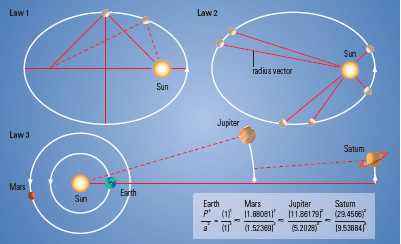
Kepler has three laws of planetary motion. These three laws were:
1.) "The orbit of a planet is an ellipse with the Sun at one of the two foci."
2.)"A line segment joining a planet and the Sun sweeps out equal areas during equal intervals of time."
3.)"The square of the orbital period of a planet is proportional to the cube of the semi major axis of its orbit."

Below is an image of Kepler's Laws:

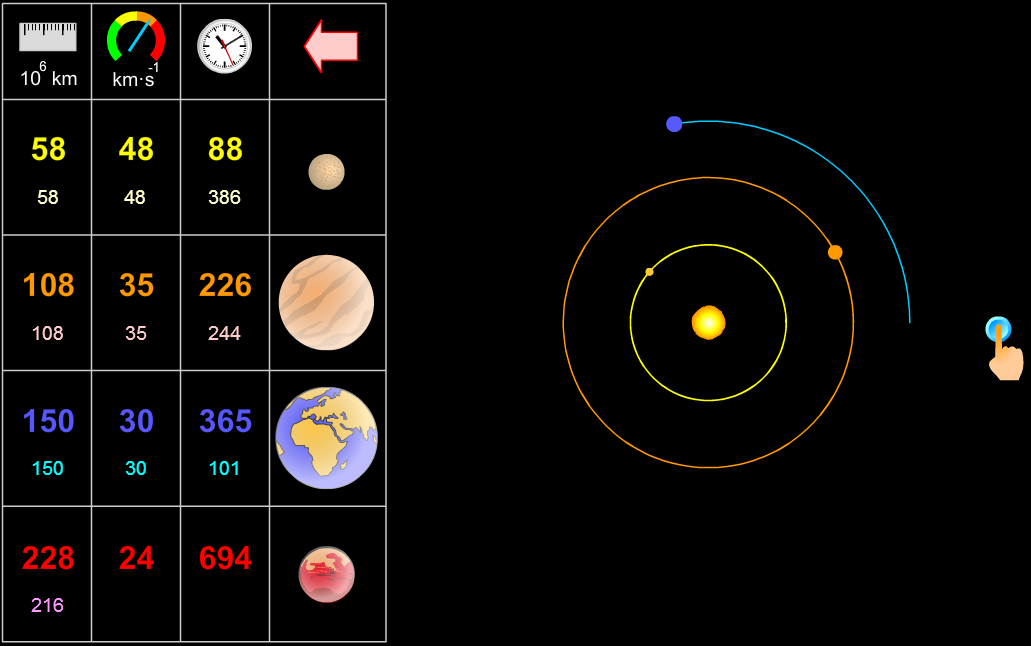
An example of Kelper's Laws is listed below in an image, This is very similar to the example we did of Kepler's Third Law which is also below.


 In my MSED 252 class we created a table dealing with Kelper's 3rd Law. We created the table below in an excel sheet as an example of these laws.

Planet Orbital Period (year) Orbital Period Squared Distance in AU (Cubed Root of orbital Period Squared)
Mercury 0.24 0.06 0.39
Venus 0.62 0.38 0.73
Earth 1.00 1.00 1.00
Mars 1.88 3.53 1.52
Jupiter 11.86 140.66 5.20
Saturn 29.46 867.89 9.54
Uranus 84.01 7057.68 19.18
Neptune 164.80 27159.04 30.06

Friday, August 28, 2015

Earth Science for Educators

#1: What is Science?
If you ask people what they think science is, no two people will answer exactly the same way, but that doesn't mean what they define science as isn't similar. With most people you will find that all in all they're general idea of what science is, is the same. Science is three main things; it is 1.) A body of knowledge, 2.) a way of doing things, and 3.) the cross cutting of relationships. You will find that if you break down what people tell you they think science is after asking them, their answers will fit into one of all three of those categories.

#2: Earth Science Questions Include...
 How do Earth’s atmosphere, ocean, biosphere, and lithosphere interact on all time and space scales?
We can think of an answer to this on a simpler scale. Take the water cycle for example. You can see in the picture placed below, that for the water cycle to come full circle the water has to go through each component of the Earths atmosphere (the run off), ocean (the ocean the water is evaporating out from), Biosphere (the condensation of the water in the clouds that later precipitates back to earth), and the Lithosphere (the water in the infiltration). 
 
How can we use measurements to describe and understand Earth’s dynamic system?
System dynamics is a type or version of system theory's in a form of a method used to help understand the dynamic behavior of complex systems, such as the Earth. We can use measurements to help describe this by creating models of the actual earth on a smaller scale. We can use specific forms of measurements like sonar to track depths of the ocean to help us understand earths dynamic system in terms of the tectonic plates under the oceans surface and measure their changes. 
What has been the impact of human activity on Earth?
Humans have had both a positive and negative impact of the Earth, but in the bigger over all picture I feel humans have mostly negatively impacted the Earth. Humans are that of a very destructive species. We are very destructive in almost everything we do and we really are only looking out "for number one".  We do very little to repair what we have destroyed and just continue to take from the Earth. We tear down forests, dump oil and other waste in the oceans, burn and bulldoze miles and miles of forests and wild life and so much more just to create space for a new factory, to get rid of waste, and to dig up fossil fuels. We do a lot to the Earth while putting very little thought into the repercussions that our actions might have. In turn we are destroying the only planted we have to call home and creating a mess bigger than we are able to clean up. I was always told for every tree you kill or destroy plant 3 more. I think more people should live with that same thought in mind. 
What is the future of our environment under climate change, land use change, and water use change?
The future for those things at this point in time is looking pretty bad. We are already seeing a lot of proof in climate change with the melting of the glaciers being one example. Our climate overall is warming up due to the hole in our ozone from global warming because off the green house gases we are constantly burning. Land use change is also something that is drastically changing. you see climates changing which is changing the environment in areas which in turn is changing the way the land is and what it can and is used for. I see the use we have of our water changing in the very near future. Since the glaciers are melting we are loosing fresh water faster. Not only are we loosing it because we are using much more of it a lot faster than we used to, but also because the glaciers are melting and that water is getting mixed into our oceans and other non fresh bodies of water. 
 How accurate are climate system models?
How accurate climate system models are depend the ones you're looking at, like anything. But ones that are done right, or well are fairly accurate. They are just about as accurate as they can get for the types of technologies and knowledge we have. None of them are going to be perfect but they can be done pretty reasonably if there is enough data gathered.

Thursday, December 11, 2014

New Celebration

At the beginning of this semester I wrote a celebration about a time when I was kayaking and I had a Blue Heron flow me all the way down the river (if you haven't read it please look back to my previous posts and check it out). Now that it is the end of the semester I am going to write about a new celebration that has happened to me. To recap, a celebration is a way of recognizing something amazing in nature that you experienced. I was initially going to write about the changing of the leaves, because up here in the U.P, there is nothing as gorgeous as the changing of leaves. But just the other day as I was wrapping up my experiment, I saw a gorgeous sunset out of my classroom window and I decided then, that is what I wanted to write my celebration about. There is a picture of this beautiful sunset below. I chose to write about this because I am a sucker for a good sunset, but there was something magical about this sunset. The beautiful things about sunsets are they happen every night, but they aren't all the same. There are always some nights where the sun setting looks prettier than other nights. That is what I love about sunsets. What I loved about his particular sunset was how it reflected off the clouds like a priceless painting. It didn't even look real, it instead looked like a piece of art. I get this happy and indescribable feeling inside when I watch sunsets. Seeing that one that night made me feel calm, and took me back to beach nights as a kid. It took me back to a time when I was able to be at the beach all day until the sun was setting and I would fall asleep in my mom or dads arms. That's what I love about sunsets, the peacefulness and the memories they bring.

Bottle Habbitat

At the beginning of the semester each of our lab groups created a bottle habitat out of 2 liters, sponge corks, string, soil, plants and water. Now that the semester is over, I have looked at our habitat and I am pleased to say it is still alive and thriving. From what our professor tells us, so long as it doesn't get opened and none of the seals break, there is no limit of time to how long they can last. This is because it has adapted to its own environment and still gets sunlight. Because the plants inside are still getting sunlight, and will constantly have water, they can still go through photo syntheses which allows them to keep on living. I honestly can say I never though that these would make it to the end of the semester, but I have been proven wrong. I am not only confident that these bottle habitats work, but I also believe that if left how they are, they really will flourish forever. I am so convinced that I really want to use this project in my classrooms when I become a teacher. Below I have pictures of my habitat for you to check out.